

FastMoss has a lot of buttons. You only need a handful of them to find products that actually sell. This is the 7-step workflow I’d follow to go from “no idea what to sell” to a short list of products with real demand behind them, including the exact numbers to check and the red flags that should make you walk away.
No account yet? Start the 7-day free trial (no card) and follow along with the dashboard open.
The workflow in one table
| Step | Where in FastMoss | What you’re looking for |
|---|---|---|
| 1. Pick a market | Country menu | The market you’ll actually ship to |
| 2. Find rising categories | Market Pulse | Growth, not just size |
| 3. Filter products | Find Product | Order growth, price, commission |
| 4. Read the product card | Product detail | Steady units, many affiliates |
| 5. Check the sales curve | Product detail | No single spike |
| 6. Check who sells it | Creators, shops, ads | Sales spread across many sellers |
| 7. Turn data into content | AI tools | Hooks and angles you can test |
Step 1: Pick your market first
Set the country at the top of the dashboard before you do anything else. FastMoss covers 20+ countries and regions, and the data looks completely different from one to the next. A product that’s saturated in the US can still be early in the UK or Southeast Asia, and the other way around.
It sounds obvious, but researching the wrong market is the most common mistake I see. Use the one you’ll actually sell in.
Step 2: Find rising categories in Market Pulse
Open Market Pulse. Use Category Panorama to see the last 28 days, and Daily Rankings to see what’s moving right now. You’re looking for categories where sales are growing, not just categories that are big.
Here’s how I read them:
Big and flat means crowded. You’ll be fighting on price.
Small and growing means room. You can win with better content.
Growing for 3+ weeks is a trend. A one-week jump is often a single viral video.
Pick one or two categories and stop there. Going deep in one niche beats skimming ten.
Step 3: Filter products by growth
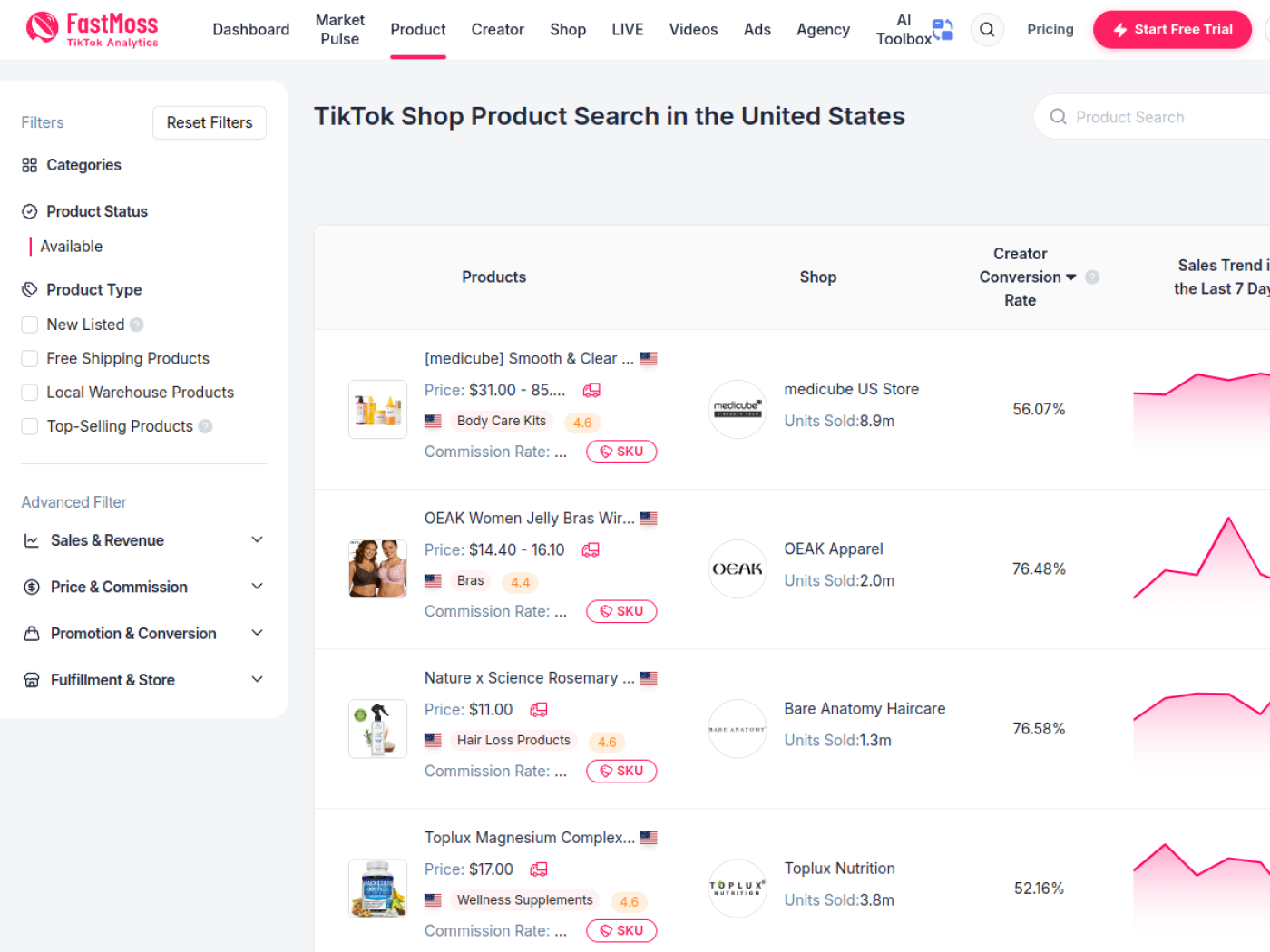
Go to Find Product and stay inside your category. These are the filters I’d set:
Order growth. Positive over the last 7 days. Higher is better, but anything steady above 5% deserves a look.
Price. A range you can source at and still make money after TikTok fees, shipping and creator commission.
Commission rate. If you’re an affiliate, filter for 15% or more. If you’re a seller, note what competitors pay so you can match or beat it.
Number of shops. A few shops selling it proves demand. Dozens means a price war.
Save the best 10 to 20 to Favourites. Basic holds 100 records per section and Pro 500, so you won’t run out of room.
Step 4: Read the product card
Open each saved product. The card puts the numbers that matter in one place.
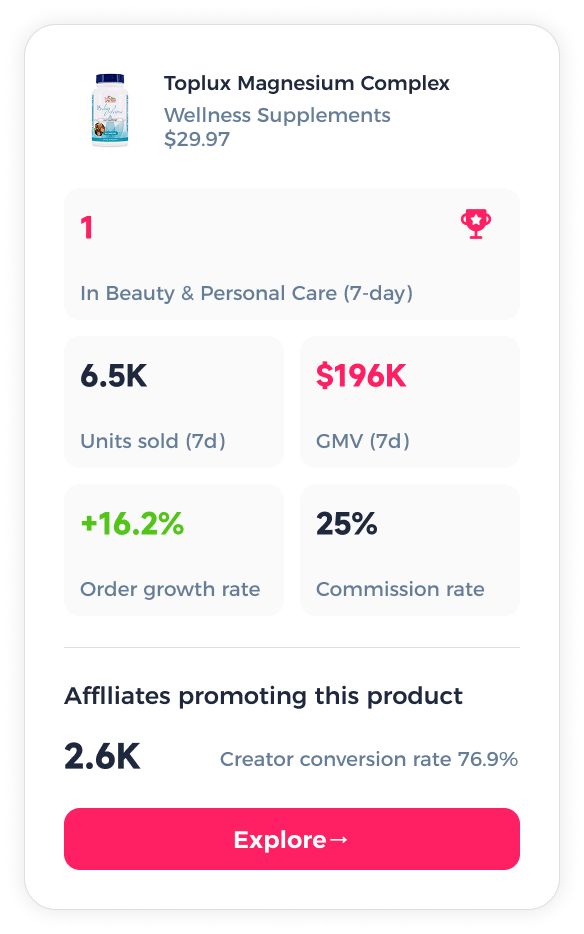
Let’s read the sample card above together:
| Metric | Sample value | What it tells you |
|---|---|---|
| Category rank (7-day) | #1 in Beauty and Personal Care | Proven demand right now |
| Units sold (7d) | 6.5K | About 930 a day. A real seller |
| GMV (7d) | $196K | The revenue it’s moving |
| Order growth | +16.2% | Still climbing, not fading |
| Commission rate | 25% | Attractive for affiliates |
| Affiliates promoting | 2.6K | Lots of creators already selling it |
A rule of thumb I like: many affiliates plus rising orders is a good sign that the product sells for ordinary creators, not just for one big account. That’s the kind of product you can actually replicate.
The flip side: 2,600 affiliates also means competition for attention. For a seller, that’s validation. For a small affiliate, it means you need a fresh angle, not a copy of what everyone else posts.
Step 5: Check the sales curve
A product that spiked once from one viral video is risky. A product with steady sales from many videos and creators is safer. Look at the trend line on the detail page and sort it into one of three shapes:
Steady climb. Best case. Demand is building.
Saw-tooth. Sales jump every time a creator posts. Fine, but you’ll need a steady flow of content to keep it going.
One tall spike, then flat. Skip it. The moment has passed.
Pro gives you 180 days of history and Ultimate 1,200 days. That longer view is how you catch seasonal products before you buy stock for Q4.
Step 6: Look at who sells it
Creators tab. Are sales spread across many creators? Good. Is one creator doing almost all of it? Fragile. If they stop posting, sales stop.
Shops tab. Check competitor prices and how many shops joined recently. A wave of new shops usually means prices are about to drop.
Videos and ads. Note the hooks, video length and angle of the top content. If an ad has been running for 30+ days, it’s very likely profitable.
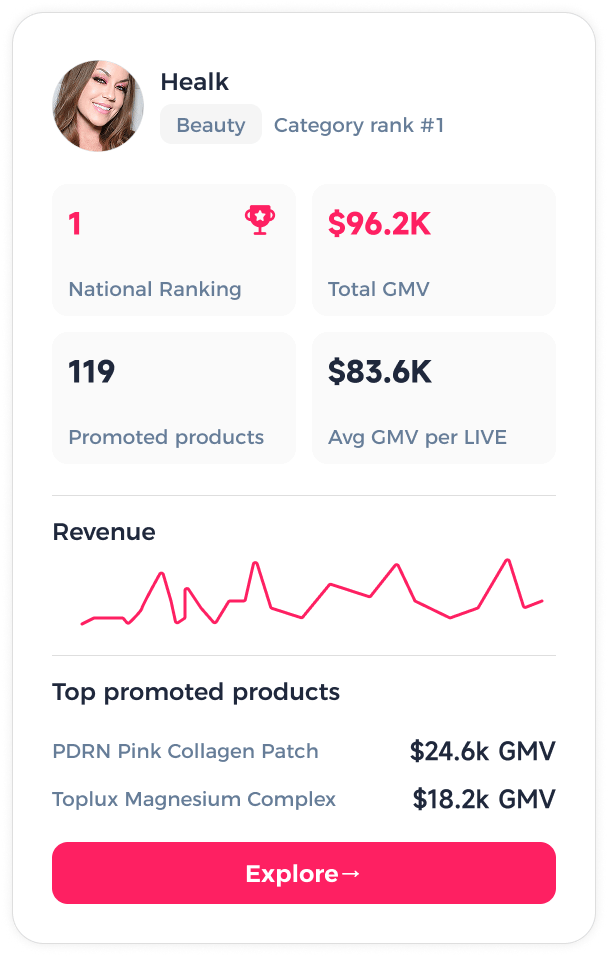
If you plan to work with creators, shortlist the ones who already sell similar products. Their audience is primed to buy, and they already know how to talk about that kind of item.
Step 7: Turn data into content
Run the top video through the AI video transcription tool, then use the script tool to write your own version. Don’t copy it word for word. Use it to understand the structure: the hook, the demo, the proof, the call to action.
Then open AI review analysis on the product. Look for what buyers love and what they complain about. The complaints are the best part. They tell you what to fix if you’re sourcing your own version, and what to promise if you’re making content.
A quick worked example
Say you sell in the US and Market Pulse shows Beauty and Personal Care growing steadily for a month. You filter for products between $15 and $35 with positive order growth and at least 15% commission. One supplement shows 6.5K units in 7 days, +16% order growth, 25% commission and 2,600 affiliates.
The curve is a steady climb, not a spike. Sales are spread across hundreds of creators. Two shops dominate but a dozen smaller ones are selling too. That’s a product worth testing. If instead one creator drove 70% of the sales and the curve was a single spike from last week, I’d pass, no matter how big the numbers looked.
Checklist for a winning product
- Growing category, not just a big one
- Steady (not one-spike) sales curve
- Positive 7-day order growth
- Many creators and affiliates selling it
- Healthy margin at the market price, after commission
- A clear video angle you can improve on
Red flags
All sales from one creator. If they stop posting, sales stop.
A price war. Dozens of shops with near-identical listings and falling prices.
Restricted categories. Check TikTok Shop rules before sourcing anything in health, supplements or beauty with strong claims.
A trend that already peaked. If the curve has been falling for two weeks, you’re late.
Which plan do you need for this?
Basic works for one category and a weekly check. If you research daily or export lists, Pro (300 searches a day, top 1,000 results, 100 exports a month) is far more comfortable. See FastMoss pricing, and save with the FAST50 promo code.
Prefer asking questions over clicking filters? FastMoss has an MCP for Claude and ChatGPT. See the FastMoss API and MCP guide. Still comparing tools? Read Kalodata vs FastMoss.
How often should you repeat this?
Weekly for the category you sell in. Trends on TikTok Shop move in weeks, not months. A quick Monday check of Market Pulse and your saved products catches changes early.
Monthly for a wider look. Check one or two adjacent categories for new opportunities.
Before every season for a deep dive. Before Q4 especially, use the longest history your plan allows to see what peaked last year.
Sellers vs affiliates: same tool, different questions
Sellers and affiliates use the same filters but care about different numbers.
A seller asks: can I source this at a good price, is demand steady, and how many shops will I compete with? Margin and competition matter most.
An affiliate asks: does this pay a good commission, does it convert for creators my size, and is there room for a fresh angle? Commission rate and the spread of sales across creators matter most.
If you’re both, run the workflow twice with different filters. The products that pass both versions are often the strongest.
FAQ
How do I find winning products on TikTok Shop with FastMoss?
Pick your market, find a growing category in Market Pulse, filter products by 7-day order growth and price, then check the sales curve and how many creators sell each product.
What is a good order growth rate on FastMoss?
Any steady positive growth is worth a look. Products growing 5% to 20% week over week with many affiliates are usually safer than one-off spikes.
Can I do FastMoss product research for free?
Yes, during the 7-day free trial. After that you need a paid plan, starting at $49 a month or $47 a month billed yearly.
Which FastMoss plan is best for product research?
Pro for most sellers. It gives 300 searches a day, top 1,000 results and 100 exports a month.